Light made me think about the lack of it: darkness, depression, isolation. I started with the music “Nothing is gonna hurt you baby” by Cigarettes after Sex. I find this pieced music very atmospheric and emotional. Then I filmed my father walking away in a small space, moving away, and light changes occurring. I asked him to stay as emotionally blank as possible, to add an element of distance.
I used some footage of outside sunlight to contrast with the indoors, and chose just black and white to try to have a more homogeneous and cohesive film. I tried to relate to the music whilst editing, trying to create some rhythm to the edit and staying with the mood of the music.
This week’s 60 second film evolved from my initial plans to a quite different result. In the end, I had to rethink and adapt because of cost, time, and technical challenges, which I’m sure happen also in real life film projects.
I focused on the hand as protagonist of a horror narrative, linked to the knife crime crisis in London.
I tried to expand my knowledge of Premiere Pro by using new (to me) effects such as blurring around the edges and colour tints. In the film, we go from a red tint to a cooler, calmer one as the crisis passes.
Thinking about bodies and hands, I looked up how to say “The End” in British axing Language and included it as the last image.
The music I used is a cover version of “Midnight the stars and You” which I found on YouTube. The slightly weird singing makes it creepier, and I liked keeping the reference to ”The Shining”.
These were my initial thoughts:
I want this film to be created though a calculated, balanced mix of stop motion animation and real life.
The underlying theme would be body horror, not unlike the works of David Cronenberg, tough I want to have limits. There will be a narrative, but no narration, as I have seen experimental films work without having to lay every detail out in plain English. I want to film the first scene in the garden near the main campus and the next scene in my bathroom.
It will follow an unnamed flesh-craving zombie and it’s struggle for identity. This short film is meant to mess with the average viewer on a deeply psychological level, not unlike “The Shinning”, Eraserhead, American Psycho or Shutter Island. Another connection to those films is that some questions they raised, and this one raises, are meant to be left unanswered so the viewer can make their own answer.
Props: A mask for me to wear, to make me appear near or past death. I could buy and put on special effects make up. A heart or a lung (bought from a butcher at a cheap price) and stab it while someone films me. Lychee, which I would eat while being filmed, so it would seem I am eating an eye. Fake blood to put on the mask or the heart or lung I buy.
The film ends with the zombie choking on meat and dying, hence the title.
Scene 1 – a corpse lies in a garden, pale and unmoving. It turns to healthy person, alive but unconscious. The turn back into a corpse and their eyes open.
Scene 2 – the corpse walks into a bathroom and looks at a mirror. In mirror we, once again, we see a healthy, living body. The reflection raises a hand and we see the corpse raise its own hand. We then see a heart and then the heart is stabbed with a knife. We the corpse stabbing the heart and eating an eye (lychee). The corpse starts gaging and choking. It falls on the floor and writhes before dying. Again.
I will sing “Midnight, the Stars and You” and then add it to the film, in a deliberate and loving homage to the shining. I sing it because “the shining” is a well-known horror film.
There was a revolving door and I saw a few lit candles near pictures of Jesus
I saw four screens at the end of a hall, each with a person martyring him or herself.
One man was curled on the floor, then was pulled up by the feet and had icy cold water poured on them. We was finally pulled up and away to parts unknown.
One man sits alone and in silence on a chair, sparks reign down around him but he ignores them. The sparks ignite and start a blazing fire that flourishes into a raging inferno but he man ignores this as well, and thought the chair he sits on catches fire, he remains unburnt.
Another was shown in total and utter reverse, starting with a unidentifiable, nebulous person almost completely buried under a pile of grating sand. The sand is slowly pulled upward and sucked of offscreen. The person is more and more uncovered, like an ancient monument being uncovered by archaeologists. The person, reveal to be a man in white, gets to his feet and once the sand is gone altogether he stands in silence.
Another shows a woman being held by her feet and hands. She blown by tremendous, fearsome winds. She wear a white dress and was the one that least intrigued me.
Another video in another room on the other side of the church, only a short walk away, shows the symbolism of Mary, starting with a bald black woman in a red dress breastfeeding an infant, healthy, clean looking river near some mountains, then showing a live campfire, a comparing crouching near it (presumably for warmth), a dark and bleak forest, a cactus, a line of dead fish, a house on a dark night,a of Mary in a blue hood holding and looking at a dead Jesus,
One of the aims of the experimental film module is going to see experimental film work in situ, so we went to the Tate Modern to see the work of Nam June Paik, the ‘godfather’ of video art.
Below are some of my thoughts about his work.
“TV BUDDHA“
” TV Buddha” shows the Buddha in a seated position with an image of him being reflected through a TV screen.
I found the uncomfortable juxtaposition between the meditating Buddha and the TV monitor interesting, as people meditate to disconnect from technology. I would never meditate in front of a TV monitor as it represents the very thing I want to seek solace from when I meditate.
When we meditate, we seek to confront ourselves, but Nam June Paik superficialises the Buddhist form of self-reflection by placing this TV Monitor infront of the Buddha.
I feel like TV Buddha also plays on our identity being slowly constructed and created through another reality, in this current age we are often represented through electric currents pixelated onto a screen, our consciousness being reflected through a digital medium…something that did not exist in Gautama’s lifetime.
It also reminded me of W.E.B Dubois’ concept of having a ‘double consciousness‘ – a psychological challenge or internal conflict that oppressed persons feel about their identity being fragmented, feeling that their sense of self is partly influenced by how they are viewed by the oppressor.
In this context, the Buddha was the oppressed and the TV was the oppressor, representing the inescapable wrath of Western ‘globalisation’ transmitting the identities and bodies of the Other onto a TV Screen that can be broadcasted for the world to see.
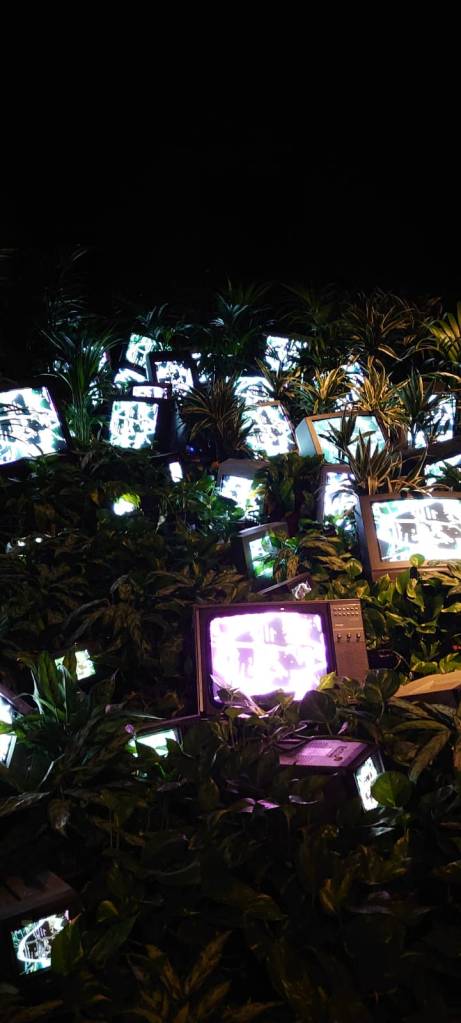
“TV GARDEN”
“TV Garden”
Upon entering the exhibition, I saw an installation of an array of TV sets that appear to grow from the luscious ‘garden’ of foliage in a dark room, with the TV sets being the only light source. Different images of people and objects glared on the screen whilst the foliage remained still and immobile.
Something seemed off about TV sets being nestled in flora and fauna and to me, it seemed like the representation of the relationship between man and nature as throughout human history we have had a desire, an everlasting need to conquer and claim unexplored spaces. TV sets represented this achievement, as in the era of the digital age we are now able to explore everything – satellites allow us to see into the deepest corners of the Borneo to the Amazon – we have successfully conquered nature.
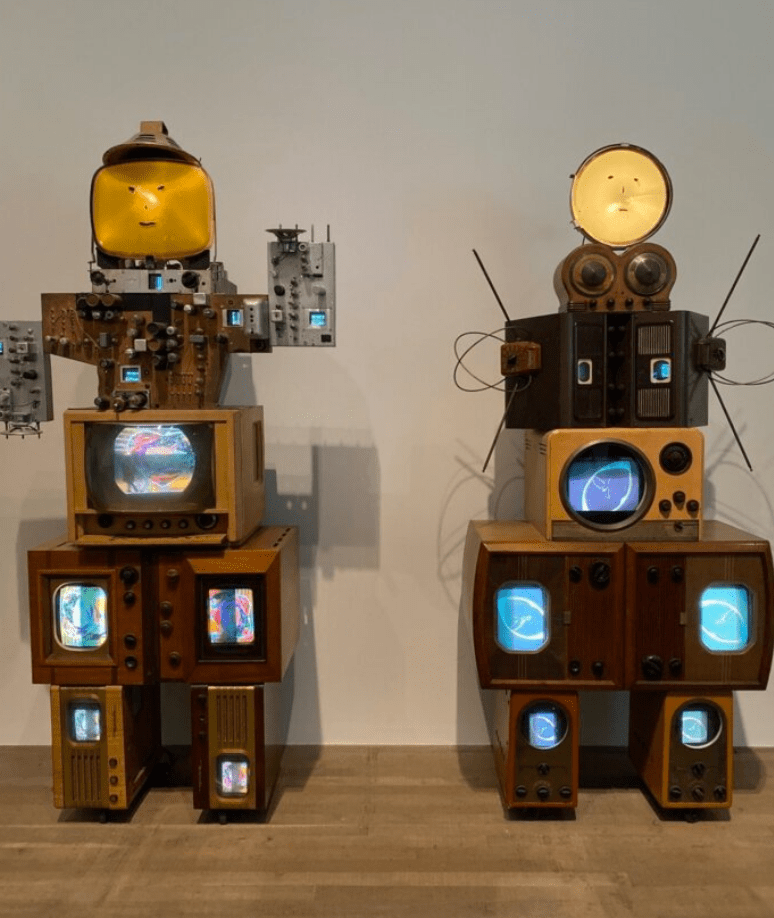
“UNCLE AND AUNT”
Uncle & Aunt, 1986.
What I found interesting about Uncle & Aunt was the fact that these robots were a part of a robot family he created, using newer monitors for the younger members of the family, representing the technological innovations of humans over time.
All in all I very much appreciated the fact I got to see this fascinating exhibition. Seeing his work instantly made me think Nam June Paik was a humorous guy, who also had a deep passion to explore his Korean and East-Asian side through his work and I think his use of Buddhism showed his passion to explore Buddhist thought around the human mind and the link it has with our technological innovations.

 Tomás
Tomás 